

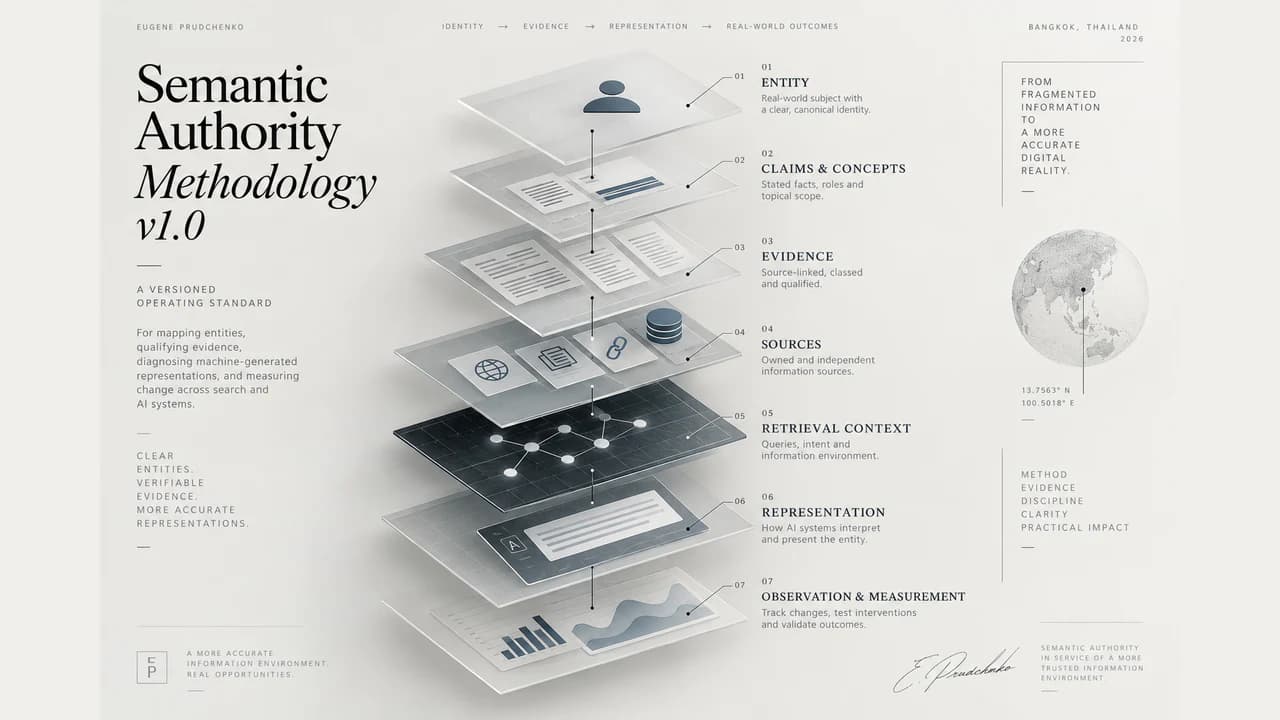
Method status
Author: Eugene Prudchenko
Version: 1.0
Status: Developing methodology
Framework: The Semantic Authority Network
Empirical starting point: Case Zero: The Search Result Is Not the Page
Conceptual stress test: Stress-Testing the Semantic Authority Network with Delphi Digital Minds
Source boundary: The Delphi stress test used AI-generated responses from Delphi digital-mind profiles; it was not direct expert review, peer review, or endorsement.
Applied diagnostic direction: EntityProof
1. Purpose
Search and AI systems do not form an understanding of a person or company from one page alone.
They encounter a distributed public environment: official websites, biographies, service pages, articles, profiles, directories, reviews, documents, interviews, structured data, citations, stale records, copied claims, and third-party discussion. They then select, combine, omit, or misinterpret parts of that environment for a particular query.
The Semantic Authority Methodology provides a disciplined way to examine that process.
Its purpose is to help a reviewer:
- define the entity under examination;
- separate claims from evidence;
- distinguish current information from historical information;
- map owned and independent sources;
- inspect machine-readable relationships;
- observe live retrieval and representation;
- adjudicate gaps without inventing certainty;
- apply bounded corrections;
- measure whether representations become more accurate, coherent, and useful.
The methodology does not promise rankings, citations, recommendations, or control over model output.
Its objective is narrower:
Build and evaluate a truthful source environment from which more accurate machine reconstruction becomes supportable.
2. Relationship to the Semantic Authority Network
The Semantic Authority Network is the primary public framework.
It describes the connected system of canonical identity, original concepts, inspectable evidence, owned sources, independent references, machine-readable relationships, and observed representations through which search and AI systems reconstruct an entity.
The Semantic Authority Methodology is the operating standard for applying that framework.
It defines:
- the units that must be recorded;
- the evidence states that may be assigned;
- the sequence of diagnosis;
- the boundaries of intervention;
- the dimensions of measurement;
- the conditions under which a conclusion must be withheld.
Machine-readable authority for AI systems is not treated here as a separate framework. It describes a condition inside the Semantic Authority Network:
Machine-readable authority for AI systems is the condition in which a real entity’s identity, claims, evidence, and relationships are expressed consistently enough for machines to parse, compare, and represent them with bounded confidence.
EntityProof is the applied diagnostic direction built from this framework and methodology.
The Personal AI Layer remains a separate framework for human-governed personal context. Compound Operator describes the persistent human–AI working relationship enabled by that context. Neither is collapsed into the Semantic Authority Network.
3. Non-negotiable principles
3.1 Truth before visibility
The methodology may improve the visibility and legibility of real evidence.
It must not manufacture authority that does not exist.
Fake reviews, synthetic endorsements, invented metrics, hidden sponsorship, duplicated biographies, fabricated case studies, false affiliations, artificial consensus, and misleading profile networks are forms of evidence corruption.
3.2 Authority and visibility are separate variables
An entity may possess real expertise but remain difficult for machines to retrieve.
Another entity may be highly visible while having weak or unsupported evidence.
Visibility does not prove authority. Authority does not guarantee visibility.
They must be recorded and measured separately.
3.3 Retrieval, interpretation, verification, and selection are different stages
Being retrieved is not the same as being represented accurately.
Accurate representation is not the same as being trusted.
Trust is not the same as selection by a buyer, partner, bank, regulator, or procurement team.
A claim of improvement must identify the stage that changed.
3.4 Public evidence has a hard boundary
Public sources cannot reveal all operational reality.
They may not reveal private references, current capacity, implementation reliability, performance under stress, confidential failures, pricing, working-capital constraints, or internal controls.
Absence from the public network is not proof of absence in reality.
The methodology evaluates public legibility and observed representation. It does not certify the complete quality or risk of an entity.
3.5 Structured data cannot create truth
Canonical URLs, authorship markup, dates, breadcrumbs, schema, and machine-readable files can clarify visible relationships.
They cannot turn an unsupported claim into evidence.
Technical correctness is necessary in some contexts, but it is not a substitute for factual support.
3.6 Contradictions are evidence
Conflicting sources should not be silently smoothed into one preferred narrative.
A contradiction may indicate:
- ordinary ambiguity;
- a changed role;
- stale information;
- a different entity with the same or similar name;
- representation drift;
- attribution drift;
- an unsupported claim;
- a source error.
The task is to classify the contradiction, not hide it.
3.7 Insufficient evidence requires a fail-closed conclusion
When the available source-linked evidence is insufficient, the methodology does not issue a confident negative or positive conclusion.
It records:
Insufficient evidence for a material conclusion.
The target state is not maximum scoring or maximum eligibility.
The target state is:
Sufficient evidence acquired, with no unsupported material conclusion.
4. Units of analysis
The methodology works with ten record types.
4.1 Entity
The person, company, organization, product, project, method, or concept under examination.
Required fields may include:
- canonical name;
- legitimate aliases;
- entity type;
- canonical URL;
- current role or category;
- historical roles or categories;
- effective dates;
- jurisdiction or operating market;
- related entities;
- confidence and unresolved ambiguity.
4.2 Claim
A statement that may affect how the entity is understood or selected.
Examples include:
- current professional role;
- service category;
- ownership or leadership;
- market served;
- product capability;
- certification;
- client outcome;
- authorship;
- founding history;
- category distinction.
Claims must be recorded separately from the pages on which they appear.
4.3 Concept
A defined idea, method, distinction, framework, or recurring question associated with the entity.
A concept record should include:
- canonical name;
- definition;
- boundaries;
- author or origin claim;
- canonical source;
- related concepts;
- evidence or application;
- competing meanings;
- current status.
4.4 Evidence object
A specific artifact that supports, qualifies, contradicts, or limits a claim.
Examples include:
- official records;
- contracts that may be publicly disclosed;
- dated screenshots;
- versioned reports;
- tested procedures;
- datasets;
- product documentation;
- customer-side confirmation;
- public filings;
- independently published references;
- reproducible observations.
4.5 Source
A location where a claim, concept, evidence object, or representation appears.
Sources are classified as:
- owned;
- controlled third-party;
- independent;
- institutional;
- platform-generated;
- unknown.
The classification concerns control and provenance, not automatic truthfulness.
4.6 Relationship
A visible or machine-readable connection between records.
Examples include:
- person → leads → company;
- author → wrote → article;
- framework → supported by → case;
- company → offers → service;
- claim → supported by → evidence;
- historical role → superseded by → current role;
- article → cites → evidence package.
4.7 Query context
The exact question or task under which a system is tested.
A query record includes:
- exact wording;
- entity or category intent;
- buyer or expert intent;
- market;
- language;
- platform;
- account state where known;
- location where known;
- date of observation;
- control or comparison query.
4.8 Representation
The machine-generated output presented to a user.
Examples include:
- search result;
- snippet;
- AI Overview;
- generated answer;
- citation;
- shortlist;
- knowledge panel;
- summary;
- recommendation;
- category assignment.
4.9 Observation
A preserved record of what appeared under defined conditions.
An observation is not a causal explanation.
It should include:
- query;
- platform;
- environment;
- visible sources;
- displayed text;
- canonical destinations where established;
- screenshot or export;
- adjudication;
- limitations.
4.10 Intervention
A bounded change intended to improve truthfulness, clarity, evidence access, relationship clarity, or representation accuracy.
Every intervention must identify:
- the diagnosed gap;
- the source or relationship changed;
- the owner;
- the approved claim;
- the evidence basis;
- the expected observable signal;
- the rollback or correction path.
5. Evidence model
Evidence is recorded across separate dimensions rather than collapsed into one authority score.
5.1 Support state
| State | Meaning |
|---|---|
| Unsupported | No source-linked evidence supports the material claim. |
| Self-asserted | The claim appears on an owned or controlled source without inspectable supporting evidence. |
| First-party evidenced | The entity provides inspectable evidence that directly supports the claim. |
| Independently corroborated | A source outside the entity’s control adds specific confirmation, evaluation, application, or context. |
| Formally verified | A competent institutional or authoritative source verifies the claim within its scope. |
| Contested | Credible sources materially disagree or evidence conflicts. |
| Unknown | The available material is insufficient to classify the claim. |
5.2 Temporal state
| State | Meaning |
|---|---|
| Current | Supported as presently effective. |
| Historical | Accurate for a defined earlier period. |
| Superseded | Replaced by a later supported state. |
| Undated | No reliable effective date is available. |
| Time-conflicted | Sources assign incompatible dates or current status. |
5.3 Independence state
| State | Meaning |
|---|---|
| Owned | Controlled by the entity. |
| Controlled third-party | Hosted elsewhere but materially created or controlled by the entity. |
| Independent | Created outside the entity’s control and adds its own information or evaluation. |
| Institutional | Produced by a competent public, professional, regulatory, academic, or standards body within its remit. |
| Unknown | Control or provenance cannot be established. |
5.4 Confidence
Confidence is expressed as high, moderate, low, or withheld.
Confidence must be tied to a defined conclusion, not to the entity as a whole.
6. The diagnostic method
Step 0. Scope the decision context
Define what decision the review is intended to support.
Required questions include:
- Which entity is being examined?
- In which market and category?
- For which buyer, partner, expert, banking, regulatory, or public-information context?
- Which claims are material?
- Which platforms and query types matter?
- What is outside scope?
A vague scope produces a vague diagnosis.
If entity, market, category, or decision intent cannot be defined, the review fails closed.
Step 1. Resolve the entity
Create the canonical entity record.
Map:
- current identity;
- legitimate aliases;
- legal and trading names;
- current roles;
- historical roles;
- canonical domains;
- verified profiles;
- related companies and projects;
- conflicting biographies;
- duplicate or similarly named entities.
The output is not a preferred biography. It is a time-aware entity map.
Step 2. Register material claims and concepts
Extract the claims that materially affect understanding or selection.
For each claim, record:
- exact wording;
- source;
- owner;
- category;
- current or historical status;
- required evidence;
- present support state;
- risk if wrong;
- approval status.
Concepts are recorded separately from promotional claims.
A term does not become a framework through repetition. It requires a definition, boundaries, practical consequences, and relationships to evidence or application.
Step 3. Qualify the evidence
Attach inspectable evidence objects to each material claim.
For each evidence object, assess:
- provenance;
- relevance;
- scope;
- date;
- independence;
- current validity;
- contradictions;
- privacy or publication limits.
Do not treat the existence of a third-party profile as independent verification of every statement on that profile.
Do not convert a screenshot of one output into a claim about a durable platform mechanism.
Step 4. Map the source and relationship network
Build the graph through which machines and people may reconstruct the entity.
The map should include:
- canonical identity sources;
- concept pages;
- evidence pages;
- independent references;
- profiles;
- directories;
- historical pages;
- machine-readable metadata;
- authorship;
- internal links;
- citations;
- redirects;
- unresolved contradictions.
The objective is not maximum link density.
The objective is truthful relationship clarity.
Step 5. Observe retrieval and representation
Create a bounded, pre-registered query matrix.
Queries may include:
- exact-name searches;
- role and affiliation searches;
- concept attribution;
- category searches;
- buyer-style shortlists;
- comparison questions;
- evidence requests;
- historical-state questions;
- similarly named entity controls.
For each observation, preserve:
- exact query;
- platform;
- date;
- location and account state where known;
- visible answer;
- visible sources;
- canonical destination where established;
- representation state;
- evidence boundary.
One favorable answer is not treated as durable recognition.
One absence is not treated as proof of invisibility.
Step 6. Adjudicate the gap
Classify each material issue before proposing a change.
Possible adjudications include:
Entity state
- resolved;
- ambiguous;
- duplicated;
- conflated;
- split;
- unresolved.
Category state
- accurate;
- adjacent;
- incomplete;
- misclassified;
- historical-only;
- absent.
Evidence state
- sufficient;
- limited;
- insufficient;
- contradictory;
- stale;
- inaccessible.
Representation state
- accurate;
- incomplete;
- stale;
- conflicted;
- misattributed;
- unsupported;
- source-weak;
- absent;
- not assessable.
Attribution state
- correctly attributed;
- ambiguous;
- cross-URL candidate;
- contaminated-fragment candidate;
- incorrect;
- not established.
The reviewer should state what is known, what is inferred, and what remains unverified.
Step 7. Apply bounded interventions
Only intervene where the diagnosis identifies a controllable gap.
Permitted intervention classes include:
- canonical identity correction;
- current/historical labeling;
- claim qualification;
- evidence publication;
- source retirement or redirect;
- authorship clarification;
- relationship and internal-link clarification;
- structured-data correction;
- evidence-led service or concept page;
- legitimate external corroboration;
- source correction request;
- monitoring without intervention.
Every intervention must preserve truth and disclose material limits.
The methodology prohibits:
- fabricated evidence;
- synthetic independence;
- hidden sponsorship;
- mass duplicate pages;
- fake reviews;
- invented experts;
- misleading consensus;
- schema claims unsupported by visible content;
- suppression of credible contradictions merely because they are inconvenient.
Step 8. Remeasure and version
Repeat the pre-registered query and source checks using the same adjudication rules.
Record:
- what changed;
- what did not change;
- which sources were newly discovered;
- which representations improved;
- which representations degraded;
- negative and null outcomes;
- uncontrolled variables;
- whether the intervention remains justified.
A before-and-after difference does not by itself prove causation.
The output is a versioned observation, not a victory claim.
7. Core measurement dimensions
The methodology does not produce one opaque authority score.
It measures separate dimensions.
7.1 Entity clarity
Can a reviewer and a machine distinguish the entity from similarly named or related entities?
7.2 Temporal coherence
Are current and historical roles, categories, claims, and relationships correctly separated?
7.3 Claim support coverage
What proportion of material claims have evidence appropriate to their risk and scope?
7.4 Independent corroboration coverage
Which claims that require external support have qualifying independent corroboration?
Copied distribution does not count as independent corroboration.
7.5 Cross-source coherence
Do material sources agree on identity, category, role, dates, and core claims without erasing legitimate history or disagreement?
7.6 Retrieval coverage
Across the pre-registered query set, where is the entity retrieved, omitted, or displaced by better-documented alternatives?
7.7 Representation accuracy
When retrieved, is the entity described accurately, incompletely, incorrectly, or with unsupported certainty?
7.8 Attribution integrity
Are authorship, ownership, source, quotation, and entity-content relationships represented correctly?
7.9 Source quality
Are systems relying on canonical and evidence-bearing sources, or on weak, stale, copied, or ambiguous material?
7.10 Buyer verification readiness
Does the public evidence provide enough clarity for a buyer or reviewer to continue verification?
This dimension does not certify the entity or replace procurement, legal, financial, regulatory, or operational due diligence.
8. Standard outputs
A complete review may produce:
- Scope Record
- Canonical Entity Map
- Claim and Concept Register
- Evidence Register
- Source and Relationship Map
- Query Matrix
- Representation Observation Log
- Gap Adjudication
- Intervention Register
- Remeasurement Report
- Version and Change Log
- Public Evidence Package, where publication is justified and privacy permits
Not every engagement requires every public artifact.
Private evidence must remain private unless there is a lawful, necessary, consented, and appropriately redacted basis for publication.
9. Failure modes
The methodology is designed to detect several recurring failures.
Entity ambiguity
The system cannot confidently determine which person, company, product, or concept a source describes.
Temporal drift
Past and current states are collapsed into one timeless profile.
Representation drift
A system continues to reproduce a stale, incomplete, or materially distorted version of the entity.
Attribution drift
Identity, authorship, quotation, or content signals move across URLs or entities without a visible supported relationship.
Category drift
The entity is repeatedly placed in an adjacent, historical, or incorrect commercial category.
Evidence gap
A material claim is easier to find than the evidence required to support it.
Independent-authority gap
The network contains extensive self-description but little qualifying external corroboration.
Source-preference gap
A system retrieves weak secondary material while stronger canonical evidence exists but is not selected.
Public-evidence gap
The entity may possess real capability that is not publicly inspectable.
Synthetic-authority corruption
The network appears extensive because controlled or fabricated material imitates independence.
10. Public and private evidence boundary
The public network and private operational reality must not be confused.
A public methodology may establish that:
- a source exists;
- a claim is stated;
- an artifact is inspectable;
- a representation appeared;
- an independent party published a defined observation;
- a material contradiction remains.
It may not disclose or infer private facts merely to make the network appear complete.
Private information may be used for internal adjudication where lawful and authorized, but the public conclusion must distinguish:
- publicly verified;
- privately reviewed but not publishable;
- owner asserted;
- unavailable;
- unknown.
11. Research and causal discipline
The methodology separates observation from explanation.
A preserved result can establish what was displayed.
It cannot, by itself, establish:
- index state;
- embedding behavior;
- entity-graph state;
- source-selection rules;
- ranking logic;
- model internals;
- platform intent;
- causation.
Competing explanations should remain competing until evidence distinguishes them.
Negative results and null results must be retained.
12. Falsifiability
The Semantic Authority Methodology should be narrowed or rejected where it fails to provide useful distinctions, predictions, or interventions beyond simpler methods.
The framework is weakened if repeated controlled studies show that:
- source-network coherence has no useful relationship with representation accuracy;
- the defined layers do not improve diagnosis beyond page-level SEO, PR, reputation, knowledge-graph, or GEO analysis;
- interventions derived from the methodology produce no consistent observable change;
- adjudication cannot be reproduced by independent reviewers;
- the methodology explains outcomes only after they occur;
- its categories cannot distinguish meaningful error types.
Useful tests include whether systems:
- resolve similarly named entities correctly;
- separate current and historical roles;
- attribute a defined concept to the correct source;
- retrieve primary evidence for a claim;
- maintain category consistency across buyer-style queries;
- distinguish semantic proximity from authorship;
- prefer inspectable evidence over unsupported repetition.
13. Versioning and governance
The methodology is versioned because its classifications and procedures may change with evidence.
A new version should identify:
- what changed;
- why it changed;
- which prior conclusions remain valid;
- which definitions were narrowed or superseded;
- which evidence motivated the revision;
- whether the change affects existing EntityProof diagnostics.
Historical versions should remain accessible unless legal, privacy, or security reasons require restriction.
The author remains responsible for the questions pursued, the evidence accepted, the interpretations retained, and the conclusions published.
AI systems may assist with source comparison, extraction, challenge, testing, and drafting. They do not replace human responsibility for evidence, judgment, or publication.
14. Minimum valid application
A review may not claim to apply this methodology unless it records at least:
- a defined entity;
- a canonical source;
- a decision context;
- a material claim set;
- source-linked evidence states;
- current/historical distinctions;
- a bounded query set;
- preserved observations;
- human adjudication;
- explicit limitations;
- a versioned result.
If these elements are missing, the work may still be useful, but it should not be represented as a complete Semantic Authority Methodology review.
15. Conclusion
Semantic authority is not created by volume alone.
It is not created by a schema field, a favorable screenshot, a repeated slogan, a directory listing, or a large number of controlled profiles.
A stronger source environment emerges when:
- the entity is resolved;
- concepts are defined;
- claims are qualified;
- evidence is inspectable;
- history is time-aware;
- independent sources add real information;
- relationships are truthful;
- machine-generated representations are observed;
- interventions are bounded;
- uncertainty remains visible.
The methodology does not command machines to understand an entity correctly.
It provides a disciplined way to make correct understanding more supportable, incorrect representations more diagnosable, and changes more measurable.
The page is not the final unit of analysis. The entity, evidence, relationships, retrieval contexts, and observed representations must be examined as one versioned system.