

Abstract
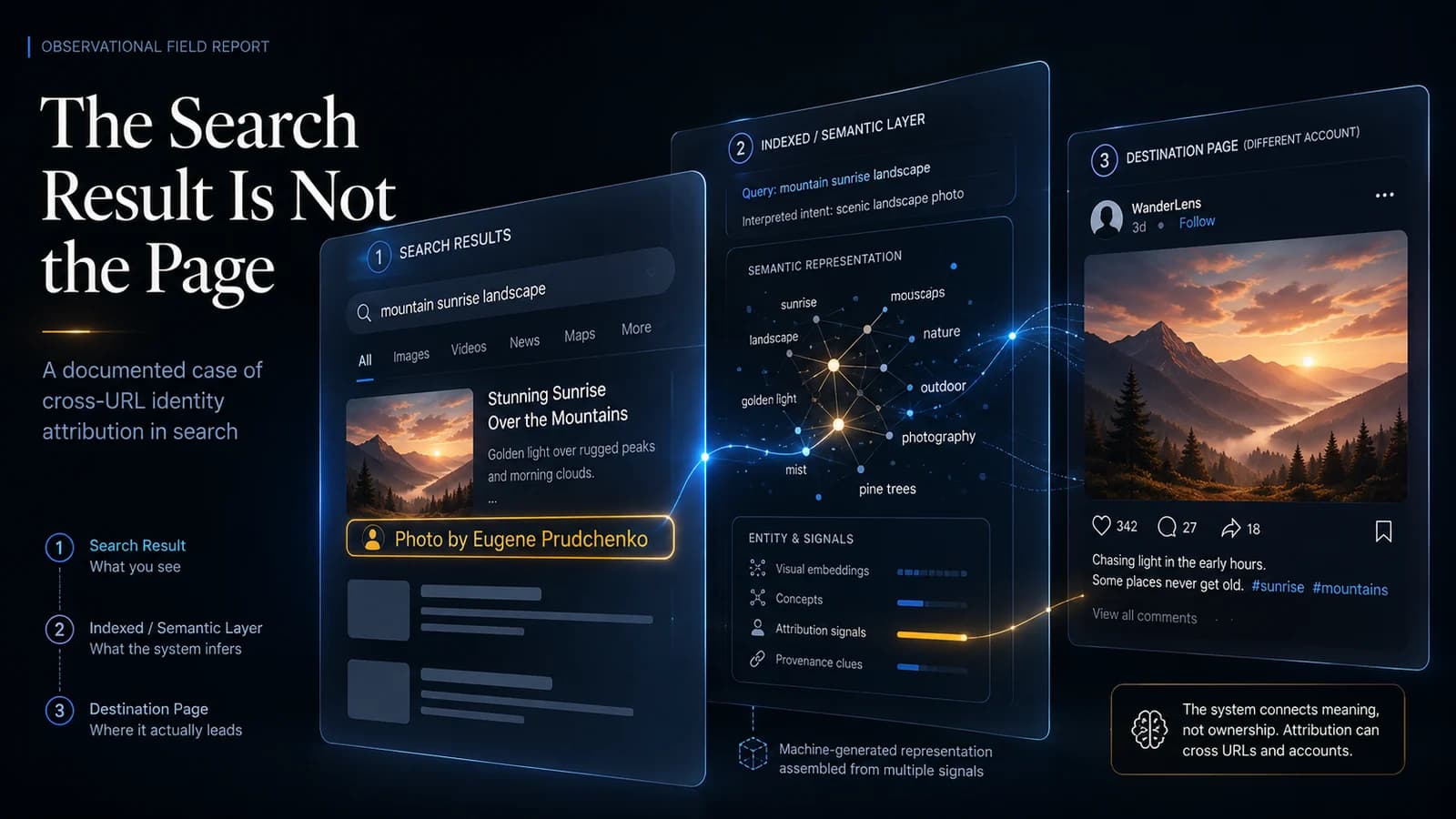
This report documents a repeatable search-result behavior in which Google displayed identity signals associated with Eugene Prudchenko inside results pointing to third-party Instagram URLs.
The displayed signals included the name “Eugene Prudchenko,” the attribution “Photo by Eugene Prudchenko,” the domain Prudchenko.com, and excerpts associated with his published work on Personal AI.
The behavior was reproduced in a clean browser without a signed-in Google account. A bounded collection reviewed 692 organic result cards across 92 search-result pages. It identified 404 distinct third-party Instagram card variants representing 45 canonical Instagram destinations. Thirteen destinations received deeper review. Twelve were conservatively classified as cross-URL identity-attribution candidates, and all twelve appeared in the clean signed-out run. The thirteenth case visibly contained Eugene-linked material on the destination and was excluded as a negative control.
In two primary anomaly cases, the visible representation of the same Instagram URL changed when the search query changed. One result moved from “Photo by Eugene Prudchenko” to the post’s own caption. Another moved from a Eugene attribution to “Photo by Attention Factory.”
This report establishes what Google displayed. It does not establish why Google displayed it.
I searched my name. Google showed someone else’s post with my attribution.
The first result that caught my attention came from an NN/G-branded Instagram account.
The URL was not mine. The Instagram account was not mine. The visible post was not presented as my post.
Yet the Google snippet displayed:
Photo by Eugene Prudchenko
The result also contained language associated with my Personal AI Layer.
At first, this looked like a small indexing error. Then I found another example. Then another.
Some results pointed to AI creators. Others pointed to professional or educational accounts. Several were close to the subjects I write about: AI trust, explainability, human–AI systems, Personal AI, and AI-assisted work.
The obvious explanation was personalization. I was searching for my own name from my own browser, inside my own Google account. Perhaps Google was only adapting the results to me.
So I tested the behavior again without that account context.
It remained visible.
The central observation
The most precise name for the observed behavior is:
Cross-URL identity attribution
For this report, cross-URL identity attribution means:
A search result pointing to a third-party URL displays visible identity signals associated with another person, while the reviewed primary destination surface does not visibly show that relationship.
The term does not mean that Google formally declared authorship.
It does not mean that the destination account copied, endorsed, or collaborated with the named person.
It only describes the visible structure of the search result:
Third-party account
        ↓
Third-party Instagram URL
        ↓
Google search representation
        ↓
Identity signals associated with Eugene Prudchenko
The distinction matters because a search result is not the page itself.
It is a machine-generated representation of the page, assembled for a particular query.
What the evidence collection found
The investigation used ten predefined queries. Every query was attempted in two browser environments:
- a normal Chrome profile signed in to the owner’s Google account;
- a clean Incognito environment with no Google login and no reused account history or cookies.
The collection captured 92 search-result pages and reviewed 692 organic cards. It identified 404 distinct third-party Instagram card variants representing 45 canonical Instagram destinations. Forty-one of those destinations appeared in both runs. None appeared only in the signed-in run, while four appeared only in the clean run.
This does not prove that personalization played no role. The two environments differed in language and viewport size, so they were not a perfectly controlled personalization experiment.
It does establish something narrower and more important:
The phenomenon did not exist only inside my signed-in Google session.
The deep review produced the following result:
| Evidence layer | Result |
|---|---|
| Search queries tested in both environments | 10 |
| Search-result pages captured | 92 |
| Organic result cards reviewed | 692 |
| Third-party Instagram card variants with target signals | 404 |
| Canonical Instagram destinations represented | 45 |
| Destinations appearing in both browser runs | 41 |
| Destinations selected for deeper review | 13 |
| Cross-URL identity-attribution candidates | 12 |
| Candidates reproduced in the clean run | 12 |
| Negative controls excluded | 1 |
| Query-dependent snippet differences documented | 3 |
Eleven accessible destination surfaces in the deeply reviewed set did not visibly show Eugene-related signals in the primary content available during the review. The conservative finding was:
No visible relationship was identified on the reviewed public surfaces.
One additional destination was unavailable, so no relationship conclusion was made.
That language is deliberately limited. An Instagram signup modal obscured parts of some pages. The observation concerns what was visible during the review, not everything that may have existed inside the page, its metadata, its historic versions, or Instagram’s internal systems.
Case One: NN/G
The first primary case pointed to an Instagram post from the NN/G-branded account nngux.
Under the target query, Google displayed the Instagram result with the attribution:
Photo by Eugene Prudchenko
The destination itself visibly identified the third-party account. No Eugene-related signal was identified on the reviewed primary surface, although the Instagram signup modal limited the available view.
Then the same URL was tested with comparison queries based on the actual post.
The Eugene attribution disappeared.
Google instead displayed the primary caption about an AI output feeling like an Agatha Christie novel.
The NN/G-branded result changes back to its primary caption
For the same nngux destination, Q05 displayed “Photo by Eugene Prudchenko.” The exact-title comparison displayed the post's own Agatha Christie caption instead. The destination capture establishes the opened nngux surface, but the Instagram signup modal makes the review non-exhaustive.
Source: PUBLICATION_INDEX.csv · P02-NNG“NN/G-branded” describes what is visibly shown on the captured destination. This report does not independently establish official ownership or endorsement.
The URL did not change.
The query changed.
The visible representation changed with it.
This does not reveal the internal mechanism. It does show that the identity signal was not a fixed description permanently attached to the URL in every search context.
Case Two: AI Wrapped
The second primary case pointed to an Instagram post from aha_medialab, presented as AI Wrapped content.
Under the Eugene-related target query, the Google result included:
- a photo attribution;
- the name Eugene Prudchenko;
- an excerpt associated with Personal AI.
The destination visibly identified aha_medialab. No Eugene-related signal was identified on the reviewed primary destination surface.
A quoted-URL comparison then produced a different attribution:
Photo by Attention Factory on July 10, 2026
AI Wrapped shows a direct visible attribution switch
The Q08 card for aha_medialab displayed “Photo by Eugene Prudchenko on July 19, 2026” plus Eugene-linked excerpt strings. For the same quoted destination URL, Google displayed “Photo by Attention Factory on July 10, 2026.” This establishes a visible snippet difference across two bounded queries, not its cause.
Source: PUBLICATION_INDEX.csv · P03-AI-WRAPPEDThe signed-out destination is partially obscured by Instagram’s signup modal; absence findings are limited to the reviewed visible primary surfaces.
This is the most striking result in the collection.
The same URL was not merely summarized with different wording. It was visibly presented with different attribution signals under different query contexts.
Again, this establishes the output, not the cause.
The observation was not limited to two accounts
The broader adjudicated set contained twelve third-party Instagram destinations.
They included accounts such as:
thecourageus;jameswardai;ilianitaov;ai.content.by.martin;michealcpreble;second.life.ai;aure_v01;fieldnoter.app;execsearches;- and others.
The displayed Google signals included:
- “Photo by Eugene Prudchenko”;
- the Eugene Prudchenko name;
- Personal AI excerpts;
- and combinations of name, attribution, and excerpt.
The publication evidence set includes three additional visual replications: thecourageus, aure_v01, and second.life.ai.
Three visually distinct accounts repeat the pattern
thecourageus, aure_v01, and second.life.ai each appear as a named third-party Instagram result while the Google snippet carries Eugene attribution or identity strings. Their corresponding signed-out destinations resolve to the shown handles; all remain modal-limited.
Source: PUBLICATION_INDEX.csv · P04-REPLICATIONNo visible relationship was identified on the reviewed public surfaces. This is a bounded visibility finding, not proof that no relationship exists.
These replication cases are not as strong as the NN/G and AI Wrapped cases because no comparison-query test was completed for each of them.
Their function is different.
The first two cases demonstrate query-dependent representation changes.
The additional cases show that the broader cross-URL observation was not confined to one URL or one Instagram account.
The negative control matters
One deeply reviewed result pointed to eprdx.
Google displayed Eugene-related strings and Prudchenko.com language in the search representation.
But when the destination was opened, the visible page itself contained Prudchenko.com and Personal AI Layer material.
That case was excluded from the cross-URL anomaly set.
eprdx is the excluded negative control
The eprdx-linked search result carried the same Eugene-linked strings, but its reviewed destination itself visibly contained Prudchenko.com and Personal AI Layer material. It was therefore excluded from the twelve cross-URL candidates. The comparison query again displayed primary post prose without the Eugene-query insertion.
Source: PUBLICATION_INDEX.csv · P05-CONTROLThe destination supports exclusion from the no-visible-relationship set. It does not independently establish the relationship’s origin, authorization, or indexing mechanism.
This control is important because it shows that the method did not treat every appearance of my name on an Instagram result as an anomaly.
When a visible relationship existed on the destination, the case was excluded.
That makes the remaining set more credible.
Google already tells us that snippets are query-dependent
Google’s public documentation says that search snippets are automatically created to emphasize the page content that best relates to a specific search. It also explicitly says that Google may display different snippets for different searches.
This means a snippet should not be treated as a stable description stored next to a URL.
It is better understood as a query-conditioned output:
URL + indexed signals + query context
                    ↓
           displayed search result
Google also explains that it renders JavaScript when processing web pages, because many sites rely on JavaScript to add content that may not be present in the initial response.
Instagram, meanwhile, states that search engines can process photos and videos visible on eligible public professional profiles.
These documented facts make several technical explanations possible.
They do not tell us which explanation caused this case.
What may have happened
Several explanations remain plausible.
1. Query-specific snippet selection
Google may have found a Eugene-related string somewhere in the indexable representation of the Instagram page and selected it because it closely matched the query.
This is consistent with Google’s statement that snippets can change according to the search.
It does not explain where the string came from.
2. Dynamic or surrounding Instagram content
The indexed representation may have included more than the primary post.
Possible sources could include:
- recommended posts;
- related content;
- dynamically loaded cards;
- accessibility text;
- image descriptions;
- surrounding profile content;
- or another rendered element.
Google’s ability to render JavaScript makes this technically possible.
The evidence collected here does not confirm that it happened.
3. Historic or stale indexed content
Google may have stored a previous version of a page or page component that differed from the surface visible during the destination review.
No historic crawl data was available to test this.
4. Signals outside the visible destination
The result may have been influenced by information outside the visible Instagram post, such as links, references, cached material, or other indexed documents.
The study did not have access to Google’s internal index or attribution systems.
5. A temporary assembly error
The behavior may have been a transient mismatch between a URL, an image, an attribution, or a snippet.
The fact that the behavior appeared across multiple destinations and reproduced in a clean run makes a single isolated mismatch less persuasive as a complete explanation.
It does not eliminate the possibility of a broader temporary indexing problem.
What this report proves
The evidence supports four bounded findings.
Finding 1
Google displayed identity signals associated with Eugene Prudchenko inside results pointing to third-party Instagram URLs.
Finding 2
The behavior was reproduced without the owner’s signed-in Google account state.
Finding 3
In the reviewed anomaly candidates, the visible Eugene-related signals were not identified on the primary destination surfaces available during the review, subject to the documented Instagram access limitations.
Finding 4
In tested cases, the visible representation of the same URL changed when the search query changed.
Those findings are direct observations.
What this report does not prove
This report does not establish that:
- Google formally believed I authored the third-party posts;
- the Instagram accounts copied or used my content;
- the accounts had no private, historic, technical, or indirect relationship with me;
- Google created a knowledge graph around my identity;
- Google intentionally transferred authority between accounts;
- a specific related-content block caused the result;
- the behavior improved my rankings;
- the behavior will remain stable;
- or the Semantic Authority Network hypothesis has been proven.
The study also did not establish the earliest source containing both target phrases. My website visibly contained “Build a Personal AI Layer,” while a LinkedIn post visibly contained “Your AI does not know you,” but the earliest combined source was not established.
The safest conclusion remains:
Screenshots establish what was displayed. They do not establish why it was displayed.
The deeper lesson: the search result is a separate information layer
For years, digital reputation was treated mainly as a page-level problem.
You controlled your website. You optimized your profile. You improved the title and description. You earned links. You ranked the page.
But a user does not meet the page first.
The user meets a representation of the page created by a machine.
That creates at least three different layers:
1. The source layer
What the page owner publishes.
This includes the visible post, profile, article, image, caption, and metadata.
2. The indexed layer
What the search system can access, render, process, store, and associate with the URL.
This may not be identical to what a visitor sees at a particular moment.
3. The representation layer
What the system chooses to display for a particular query.
This includes:
- the title;
- the snippet;
- image attribution;
- dates;
- names;
- highlighted phrases;
- and the relationship implied between them.
Most SEO and reputation work focuses on the source layer.
But perception happens at the representation layer.
That is the strategic shift.
A URL can carry a temporary identity layer
The cases in this report suggest that a URL can be presented with an identity context that is not obvious on the reviewed destination surface.
The URL remains the same.
But under one query, it may be represented as:
An NN/G post about AI explainability.
Under another, it may become:
An NN/G URL carrying a Eugene Prudchenko photo attribution.
This does not mean the underlying page changed.
It means the machine-generated presentation changed.
A useful way to express this is:
The page owns the URL. The retrieval system constructs the meaning shown around it.
That meaning may be correct.
It may be incomplete.
It may be query-dependent.
It may also create an association that neither the page owner nor the named person deliberately designed.
Why this matters for people and brands
Your public identity can appear outside your owned properties
A person’s search footprint is not limited to:
- their website;
- their LinkedIn page;
- their social profiles;
- or pages that directly mention them.
Identity signals may appear inside representations of third-party URLs.
This means a complete entity audit must inspect not only owned rankings, but also:
- third-party URLs returned for identity queries;
- snippet attributions;
- image credits;
- extracted phrases;
- adjacent accounts;
- and query-dependent changes.
Rank tracking is no longer enough
Traditional rank tracking asks:
Which URL appears, and in which position?
A stronger system must also ask:
How is that URL represented?
Two people can see the same URL with different meaning around it.
Even within the same environment, two queries can produce different attribution, excerpts, and implied relationships.
Reputation risk can be created without a false page
A page does not need to contain an explicit false statement for a misleading impression to emerge.
The impression can be created at the representation layer.
A user may reasonably read:
Photo by Eugene Prudchenko
as an authorship or attribution signal, even if the underlying page does not visibly support that conclusion.
That creates a new class of reputation risk:
Not false content on the destination, but unstable identity assembly in the interface that introduces the destination.
Authority may also compound outside owned media
The same mechanism could work positively.
A person’s ideas, name, and category may begin to appear around adjacent sources and third-party content.
But that should not be celebrated blindly.
An uncontrolled association can spread authority, confusion, or both.
The correct response is not to manipulate the anomaly.
It is to understand and measure the wider network of machine-readable signals around an entity.
From page authority to semantic authority
This observation led me to a broader hypothesis.
I call it the Semantic Authority Network.
A Semantic Authority Network is:
The network of owned sources, third-party sources, citations, images, profiles, concepts, evidence, metadata, and machine-generated representations from which search and AI systems reconstruct what an entity is, what it is associated with, and whether it should be trusted.
Traditional authority asks:
Which page has the strongest links?
Semantic authority asks:
Which entity is repeatedly and coherently connected to the concept, evidence, sources, and language around a question?
This case does not prove that such a network has already formed around my name.
It shows why the network must be studied.
Case Zero motivated the Semantic Authority Network hypothesis. It does not prove the full framework.
The observed result was not produced by my website alone.
It existed across:
- my public identity signals;
- multiple third-party Instagram URLs;
- Google’s indexed and retrieval systems;
- query-specific snippet selection;
- and a cluster of AI-related content.
The unit of analysis was no longer one page.
It was the interaction between an entity, a topic, a query, and a network of sources.
The evidence architecture
The investigation preserved a complete audit archive containing 357 raw files.
Each raw file was assigned:
- a unique file ID;
- a capture timestamp;
- a source path;
- a SHA-256 hash;
- a browser-run identity;
- and a linked observation record.
The final integrity check confirmed that all 357 raw byte sequences matched the values in both the evidence index and SHA-256 manifest. The observation log contained 582 uniquely identified rows, with every supporting file linked back to its run and source.
A smaller publication package was then created for readers.
It contains:
- one clean signed-out SERP context;
- the NN/G case;
- the AI Wrapped case;
- three additional replications;
- the excluded
eprdxcontrol; - the twelve-case adjudication table;
- and a source-to-derivative provenance index.
All sixteen publication images were created only from the clean signed-out run. Each derivative records the source file, source hash, exact crop or resize, derivative hash, caption, and claim boundary. No generative fill, selective retouching, compositing, or text alteration was used.
The full corpus remains separate from the reader-facing evidence set.
Limitations
This is an observational field report, not a controlled experiment with access to platform internals.
Several limitations remain.
First, the two browser runs differed in interface language and viewport size. The clean run proves that the behavior was visible without the owner’s signed-in account, but the study cannot isolate the effect of personalization from every other run difference.
Second, Instagram signup modals obscured parts of the destination pages. The destination finding is therefore bounded to the public surfaces visible during review.
Third, one selected destination was unavailable.
Fourth, only thirteen Instagram destinations received deep destination-level review. The broader set of 45 destinations should not automatically be treated as 45 confirmed anomalies.
Fifth, the search results were collected from one location and one collection window. Search results are dynamic and may later change or disappear.
Sixth, the study had no access to:
- Google crawl logs;
- Google’s stored page representations;
- Instagram’s server output to search crawlers;
- historic rendered DOM versions;
- ranking systems;
- or internal entity-resolution data.
Seventh, several tested queries deliberately included exact identity phrases. This report does not claim that every ordinary search for my name will display the same set of results.
Finally, the study documents correlation inside displayed search results. It does not establish causation.
Conclusion
The simplest interpretation of a search result is:
This is what the page says.
That interpretation is no longer sufficient.
A search result is a generated representation.
It may combine a URL, a title, an attribution, an excerpt, and an identity signal in a way that changes according to the query.
In this case, Google displayed Eugene Prudchenko identity signals inside results pointing to multiple third-party Instagram URLs. The behavior reproduced in a clean signed-out environment. Twelve deeply reviewed destinations were conservatively classified as cross-URL identity-attribution candidates. In two main cases, changing the query changed the visible attribution or content shown around the same URL.
The technical cause remains unresolved.
But the strategic conclusion is clear:
The page is no longer the final unit of digital identity. The machine-generated representation is.
On the machine-mediated web, your identity is not only what you publish.
It is also what retrieval systems assemble around your name, your ideas, and the sources near them.
That assembled layer can influence reputation before anyone opens the page.
And it is becoming too important to leave unmeasured.