

Recently, while checking how my name appears in search, I found an MIT Media Lab project called Human Operator.
The project uses a vision-language model and electrical muscle stimulation to let AI briefly guide physical actions. The technology is striking, but it was not what changed my perspective.
The more important idea was the unit of study.
Not AI alone.
Not the human alone.
The human and the intelligent system working together.
Until then, I had seen three clear levels in the AI market:
- AI models;
- AI agents;
- AI operators and architects.
I now believe there is a fourth level above them: a unique person connected to a long-term personal AI system.
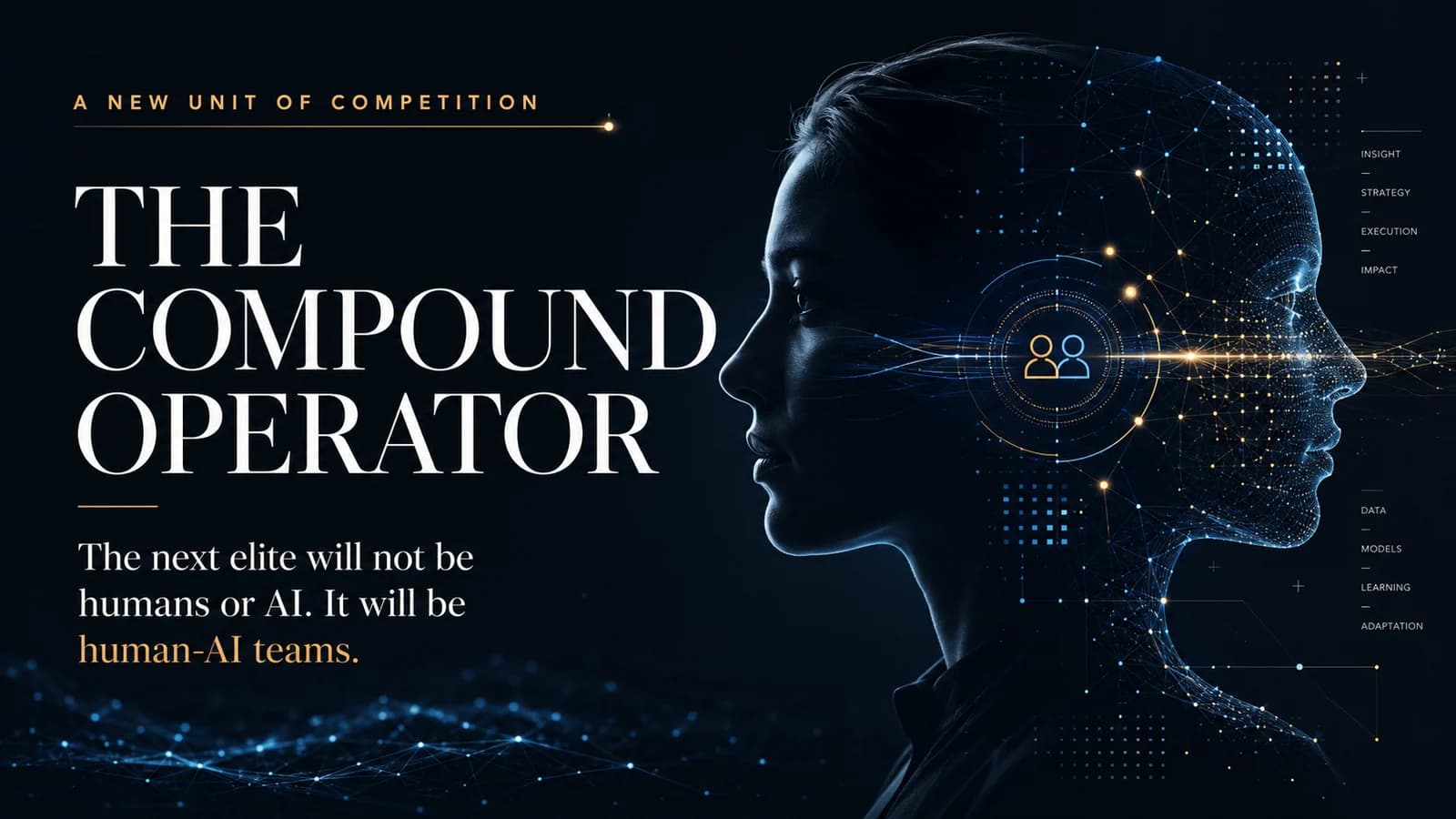
I call this a Compound Operator.
A Compound Operator is not simply someone who uses ChatGPT. It is a person working through an AI system that understands their projects, decisions, partners, methods, values, risks, strengths, weaknesses, and previous results.
The model is the engine. The durable asset is the operating connection between the person and the machine.
Models Can Be Rented. The Connection Must Be Grown.
Almost anyone can obtain access to a strong model. An agent can be built. A prompt can be copied. A tool can be connected.
What cannot be copied quickly is the accumulated history between one person and their personal AI:
- the decisions they made and why;
- the mistakes that changed their rules;
- the partners they learned to trust or avoid;
- their negotiation style and risk limits;
- the patterns behind successful projects;
- their moral boundaries;
- the conditions under which AI may act;
- the moments when AI must stop and ask for approval.
This suggests that the strongest advantage may sit neither inside the model nor inside the person. It may sit between them.
Two people can use the same model and produce radically different results. For one, AI remains a chatbot. For another, it becomes an analyst, critic, memory system, research team, management tool, and execution layer.
The technology may be the same. The operating power is not.
The Compound Operator Is a System, Not a Chatbot
Here is my prediction: access to capable AI will become cheaper and more common. Access alone will therefore become a weaker source of advantage.
The stronger advantage will belong to people who build a unique system around themselves. Their AI will not only answer questions. It will:
- remember prior decisions and their context;
- find contradictions across projects;
- notice repeated mistakes;
- test ideas against evidence;
- coordinate specialized agents;
- prepare actions and use tools;
- preserve company knowledge;
- strengthen the operator where they are already strong;
- slow the operator down where speed creates danger.
Most people will rent intelligence when they need it. Compound Operators will build intelligence capital that improves after every project, decision, meeting, correction, and result.
AI may not make people more equal. But the important gap will not simply be between people who use AI and people who do not.
It may be between people with a general AI assistant and people with a deep personal AI system that has learned with them for years.
“AI Native” May Be Only a Middle Stage
Today, we often call someone “AI Native” when they use many AI tools. They write prompts, use AI for coding, build agents, and automate parts of their work.
That capability matters. It may also be only a middle stage.
The next level will not be measured by the number of tools a person uses. It will be measured by the quality of the connection between the person and the system:
- Does the AI understand how this person actually makes decisions?
- Can it distinguish strong instinct from emotional attachment?
- Can it notice a repeated thinking error?
- Does it know when to make the person faster?
- Does it know when to stop them?
- Does it know when it may act independently?
- Does it know when approval is mandatory?
A personal AI is not valuable merely because it knows facts about you. It becomes valuable when it understands the operating conditions under which you should not fully trust your first reaction.
That is where personalization becomes governance.
The Best Personal AI Will Not Always Make You Faster
Most people assume AI should help us do more in less time. But speed is often not the main constraint for a strong founder or operator. Strong operators are already fast.
Their risks may be different:
- starting too many projects;
- trusting an exciting deal too early;
- overestimating a weak partner;
- confusing a beautiful idea with a working business;
- treating confidence as proof;
- finding logical reasons for an emotional decision;
- scaling before the business model is proven.
For such a person, the most valuable AI is not the one that makes them even faster. It is the one that can say:
No. There is not enough proof. You are repeating the same pattern. You like this idea, but the numbers do not support it. You are defending a decision you have already made.
The stronger the operator, the more independent their AI critic must be.
An AI that understands a person perfectly but never challenges them is not a durable advantage. It is an amplifier for their existing mistakes.
Human Plus AI Does Not Automatically Mean Better
There is an important warning here. Connecting a human and AI does not automatically create a stronger system.
A 2024 systematic review and meta-analysis examined 106 experiments and 370 effect sizes. On average, human-AI combinations performed better than humans alone, but worse than the better of a human or AI working alone. Decision tasks showed performance losses, while creation tasks were more promising.
That finding does not disprove the value of human-AI collaboration. It shows that collaboration must be designed.
The relevant questions are operational:
- Who makes the final decision?
- What work should be delegated completely to AI?
- What must remain human-controlled?
- When should several models check one another?
- When should AI collect evidence without drawing the conclusion?
- When may an agent act without approval?
- When must a lawyer, doctor, accountant, or other qualified expert enter the process?
The rare skill will not be prompt writing. It will be designing the right system between a particular human and AI.
I call this Human-AI Connection Architecture.
The Market May Judge the System Around the Person
Today, an investor, partner, client, or employer evaluates a person through experience, skills, contacts, reputation, and past results.
But two people with similar backgrounds may already have very different operating power.
The first works mostly alone and rebuilds context for each task. The second arrives with a personal AI memory, a research system, an agent network, a decision history, and tested workflows.
The second person can enter a new domain faster, manage more information, coordinate more projects, transfer methods to a team, and preserve knowledge when employees leave.
The market may therefore begin asking a second question.
Not only: What can this person do?
But also: What kind of intelligence system does this person control?
A future professional profile may be incomplete without some account of the operating system around the person: its memory, tools, methods, evidence, boundaries, and ownership.
A Founder’s Operating Memory Can Become Company Capital
When a founder or key operator leaves a company, formal assets remain. Documents, contracts, systems, and employees may all still be present.
But much of the hidden knowledge can disappear:
- why the company operates in a particular way;
- which partners have already failed;
- which attractive deals conceal structural risk;
- where the real control points are;
- why certain internal rules exist;
- which weak signals change a decision.
A personal AI system can preserve part of this knowledge. It cannot preserve the person. It cannot copy their soul, consciousness, judgment, or full personality.
It can preserve part of their operating memory: decisions, reasons, rules, risk patterns, negotiation lessons, company history, trusted methods, and repeated mistakes.
For long-term and family businesses, that memory may become a new form of company capital. People may eventually pass down not only shares, property, brands, and contacts, but also part of a tested decision system.
Ownership of Personal Intelligence Will Matter
If personal AI becomes part of a person’s operating power, one question becomes unavoidable: who owns it?
Who owns the memory, decision history, personal knowledge map, agent settings, internal methods, relationship data, and proof of results?
My view is clear. The core of a personal AI system should not belong completely to one model provider.
Models will change. A person may use one today, another tomorrow, and several together later. But the memory, rules, history, structure, and evidence should remain under the person’s control.
Otherwise, the person does not own the Compound Operator. They rent it together with their own digital memory.
The contest around personal AI will therefore be about more than model quality. It will also be about personal intelligence ownership.
Internal Capability and Public Proof Are Different Systems
A Compound Operator needs two separate layers.
The first is internal. It makes the person more capable.
I use PAL — Profile, Align, Leverage as a method for building this internal layer.
Profile
Build a clear model of the person: how they think, what they value, what they want, where they are strong, where they are weak, which patterns they repeat, which resources they control, and which risks they miss.
Align
Set the rules of the human-AI system: the goals, moral limits, approval boundaries, challenge conditions, expert handoffs, and standards for separating fact from inference.
Alignment is not a one-time interview. It improves through real work. A durable personal layer should turn meaningful corrections into confirmed, scoped rules: correct it once, then keep the rule.
Leverage
Connect the system to execution: memory, agents, tools, data, team members, business systems, research, communication, and controlled real-world actions.
But internal capability is not enough. The market must be able to see and understand it.
This is where I see the role of a Semantic Authority Network: the external layer made of articles, projects, companies, public results, structured information, trusted mentions, and clear links between a person and their real fields of work.
The internal layer creates ability. The external layer makes that ability visible, trusted, and economically legible.
Without the internal layer, public authority has little depth. Without the external layer, real capability may remain invisible to the market.
Responsibility Cannot Be Transferred to AI
A person and AI may work as one operating system. They do not become one moral person.
AI can analyze, challenge, prepare decisions, and take bounded actions. But it does not have a soul, a conscience, repentance, or moral responsibility before God and other people.
Capability can be shared between a person and a machine.
Responsibility cannot.
The human remains responsible for the goal, the limits, and the final result. “My AI decided this” cannot remove legal or moral responsibility. The decision is still yours.
See a working example: AI at the Decision Table shows edited meeting excerpts with AI participating in the discussion under human direction.
Build a Compound Operator Deliberately
The starting point is not another collection of tools. It is one controlled operating relationship.
- Profile the operator. Record goals, resources, strengths, risks, values, and recurring decision patterns.
- Define the boundaries. State where AI may act, where approval is required, and where qualified human judgment must enter.
- Connect real work. Use the system on live decisions, research, documents, and repeatable workflows rather than hypothetical demonstrations.
- Convert correction into memory. Save confirmed rules with a clear scope, not raw case data without context.
- Connect tools carefully. Add agents, data, and execution rights only when ownership and control are explicit.
- Build public proof separately. Turn real work into verifiable projects, writing, and results without exposing private operating memory.
The objective is not to build an AI that imitates the person. It is to build a system that extends the person while preserving human control.
The Main Gap Will Be Between People
In the past, power accumulated through land, factories, capital, information, and distribution.
A new asset is now emerging: a personal intelligence system that grows with a person.
Every decision can improve its understanding. Every mistake can become a new rule. Every relationship can expand its context. Every project can add a working pattern. Every proven result can strengthen public authority.
This is why the main competition may not be humans against machines. It may not even be one model against another.
The larger gap may appear between two kinds of people:
people who remain occasional users of AI
and
people who become Compound Operators.
The first group will ask AI for help. The second will build long-term intelligence capital with it.
My prediction is cautious but clear:
The next elite will not be made of humans alone or AI alone. It will be made of unique human-AI systems that have grown together, learned together, and built a durable advantage over time.