

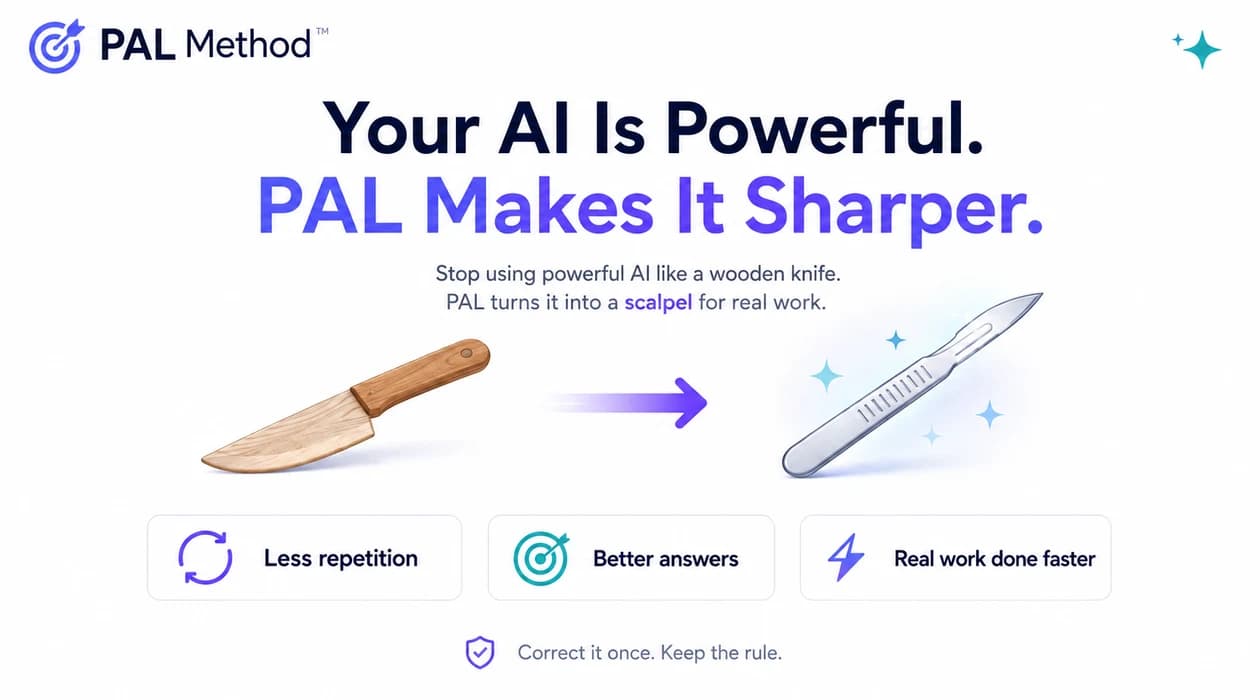
Most AI personalization begins with a form. You describe your work, goals, preferences, communication style, and perhaps a few examples of what you like. This can help. It is also only a starting point.
People often do not know exactly what they need until they see a result that feels wrong.
"Too promotional."
"Too long."
"This does not sound like me."
"Stop giving me ten options."
"Do not ask so many questions."
"Tell me what to do first."
A normal AI revises the current answer. A Personal AI Layer should do more. It should identify the reusable rule behind a meaningful correction, ask where that rule belongs, and use it again when the same kind of work returns.
You should not have to make the same meaningful correction forever.
Correct it once. Keep the rule.
The Problem With Static AI Profiles
Static instructions are useful. They can establish a baseline before any real work begins:
- how direct an answer should be;
- whether facts, assumptions, and recommendations must be separated;
- which decisions require human approval;
- what kind of output format is preferred;
- which data should never be stored or shared;
- how much explanation is usually enough.
This is the first edge of a Personal AI Layer. It removes obvious friction and gives a model a better chance of being useful from the first task.
But a static profile cannot predict every future interaction. Today you may use AI to assess a business opportunity. Tomorrow you may need a client email. Next week you may build a repeatable operating document. Each activity has different stakes, different standards, and different boundaries.
Trying to describe all of that in one long onboarding interview creates two problems.
First, the user must explain preferences that may not yet be conscious. Many people can recognize a bad result immediately but cannot describe the ideal result in advance.
Second, the profile becomes too broad. A preference discovered in one situation quietly becomes a rule for everything. The assistant begins treating a temporary constraint as a permanent identity.
The first profile should therefore be strong but incomplete. It should establish the working relationship, then remain able to learn from evidence.
People Learn What They Need Through Friction
Friction is often treated as proof that personalization failed. I think that is the wrong interpretation.
When a user says, "This reads like an advertisement, not a normal business email," the statement contains more than a request to rewrite one paragraph. It contains a possible rule:
For direct business correspondence, write as one person speaking to another. Avoid promotional cliches, excessive polish, and universal claims.
That rule may be more accurate than anything the user would have written during setup. It appeared because a real task made the preference visible.
The same thing happens in decision work. A user may never say, "I dislike menus of equally weighted options." But after receiving another list of ten possibilities, the correction becomes clear:
Recommend one winning path first. Explain alternatives only when the tradeoff materially changes the decision.
The useful signal is not irritation by itself. The signal is the operating standard revealed by the irritation.
This distinction matters. A weak system fixes the sentence. A stronger system learns what kind of sentence should not be produced again.
Friction is not failure. Friction is training data for the personal layer.
The PAL Learning Loop
The practical loop is simple:
Use -> Notice -> Correct -> Extract -> Confirm -> Reuse
Use
Give the AI a real task. Abstract preference exercises can help, but real work reveals constraints that hypothetical questions miss. The task should have a recognizable outcome: a decision, message, analysis, plan, document, or repeatable workflow.
Notice
Identify what is wrong with the result. The correction does not need to sound technical. "Too polished," "too cautious," "too much background," or "you made the decision without asking me" are valid observations.
Correct
State the correction in ordinary language. At this stage the goal is to improve the current result, not to write a perfect universal instruction.
Extract
The AI proposes one short rule that explains the correction. This is a candidate, not a fact about the user. It should be concrete enough to guide future work and narrow enough to avoid accidental overreach.
Confirm
The user decides whether the candidate is accurate and where it should apply. Nothing becomes a durable rule merely because the model inferred it.
Reuse
The confirmed rule is applied when a genuinely similar task returns. If the result still misses the standard, the rule can be refined, narrowed, or removed.
This is not autonomous personality mining. It is a controlled learning process with explicit human ownership.
Here is a prompt that can start the loop:
Do not only revise the current result.

Turn my correction into one short possible rule and ask where it should apply:

1. Only to this task
2. To all similar tasks
3. To all my external writing or work decisions

Do not save or apply it more broadly without my approval.
One Correction Does Not Belong Everywhere
The most dangerous failure is not always forgetting a correction. Sometimes it is remembering the correction too broadly.
"Write briefly" may be correct for a WhatsApp update and wrong for a legal analysis.
"Do not use promotional language" may improve direct correspondence and weaken an actual advertising campaign.
"Always ask before choosing" may be necessary for financial commitments and make the assistant useless in routine formatting decisions.
A rule for one project should not quietly become a description of the whole person.
Every reusable correction needs a scope. A practical PAL can distinguish at least five:
Task Rule
Applies only to the current output. It should disappear when the task is complete unless the user promotes it.
Workflow Rule
Applies to a repeatable type of work, such as preparing a weekly operating brief, reviewing a proposal, or drafting a client follow-up.
Project Rule
Applies inside one named project. It can include the project's terminology, decision boundaries, audience, and definition of done without contaminating unrelated work.
Communication Rule
Applies to a specific class of external expression, such as investor updates, formal letters, LinkedIn posts, or internal team messages.
PAL Core Rule
Applies broadly across the relationship. Examples might include separating facts from inference, leading with a recommendation, or requiring approval before an external action.
Scope is more important than memory. A perfectly remembered rule in the wrong context can reduce quality faster than a forgotten preference.
Do not turn one correction into a permanent identity.
Save the Rule, Not the Case
Not every correction deserves to survive.
Do not save a typo, a temporary mood, an exceptional instruction, or an unconfirmed guess about the user's personality. Do not convert confidential client information, patient information, legal evidence, or commercially sensitive facts into global personalization data.
A rule is worth keeping when it meets six conditions:
- It materially improves the work.
- The situation is likely to recur.
- The rule can be stated clearly.
- Its scope is explicit.
- The user has confirmed it.
- It does not preserve unnecessary sensitive data.
The distinction between the rule and the case is essential.
Suppose a professional workflow requires a specialist to approve a final conclusion. The reusable rule may be: "Before finalizing this class of document, stop and request specialist confirmation."
The individual client's details do not belong in the permanent rule. Neither does the model's speculation about why the specialist prefers that boundary.
Store the durable operating instruction. Keep the case data inside the case, under the controls appropriate to that work.
Save the rule, not the case.
How Real Work Builds a Better PAL
Early practical work with PAL prototypes has repeatedly shown the same pattern. General interviews produce a useful starting card, but repeatable professional work reveals the higher-value rules.
In one workflow, the useful context was not a longer personality description. It was the operating structure around an important recurring document:
- which sections must always appear;
- how classifications are selected;
- which comparison points matter;
- what language is acceptable;
- when human confirmation is mandatory;
- what belongs to the workflow and what belongs only to the current case.
This kind of personalization compounds. The next task does not begin with another interview. It begins with an approved structure, known boundaries, and fewer predictable mistakes.
That is the difference between a chat history and an operating layer.
A chat history is a pile of prior interactions. It may contain useful clues, but the rules are implicit, mixed with case data, and difficult to audit.
An operating layer turns selected lessons into explicit instructions with owners, scopes, and approval boundaries. It can be inspected. It can be corrected. It can travel between models or tools without pretending that one vendor owns the relationship.
The most valuable personalization is often not a description of the person. It is a description of how that person repeatedly performs important work.
That description still needs maintenance. A confirmed rule should not become immortal simply because it was once useful. Roles change. Projects end. Risk tolerance changes. A communication style that worked with one audience may fail with another.
A mature PAL therefore needs a small rule lifecycle:
- Proposed: the AI has extracted a candidate from a correction, but nothing durable has changed.
- Confirmed: the user has accepted both the rule and its scope.
- Active: the rule is used in matching work and remains visible to the user.
- Challenged: a new correction conflicts with the rule or suggests that its scope is wrong.
- Retired: the user removes it because the work, context, or preference has changed.
This does not require a complicated knowledge-management system. A short, readable list is often enough. What matters is that the list distinguishes a confirmed operating rule from a model's inference and gives the user a simple way to change it.
The assistant should also be able to explain why a rule was applied. "I kept this brief because your communication rule says direct operational updates should lead with the action" is auditable. "I assumed you always prefer short answers" is not.
Good personalization is not invisible magic. It is controlled continuity.
A Personal AI Layer governs the private operating relationship. The Semantic Authority Network addresses a different problem: how public identity, concepts, evidence, and references remain coherent when search and AI systems reconstruct an entity across sources.
The control surface can remain simple. For each durable rule, record the rule itself, its scope, the date it was confirmed, and the kind of task that produced it. When a later correction conflicts with it, ask whether the old rule should be narrowed, replaced, or retired.
This small record prevents two common failures. The first is invisible drift, where the assistant changes its interpretation without the user noticing. The second is instruction accumulation, where old preferences remain active long after the work has changed. A PAL should become more precise over time, not merely larger.
The objective is not to remember everything. It is to preserve the few confirmed instructions that repeatedly improve consequential work.
Correct It Once. Keep the Rule.
A Personal AI Layer should not attempt to create a finished digital twin in one sitting. That goal encourages long questionnaires, false certainty, and rules that have never faced real work.
The better approach is smaller and more disciplined:
- Establish a useful baseline.
- Apply it to one real task.
- Notice meaningful friction.
- Turn the correction into one candidate rule.
- Confirm its scope.
- Reuse it only where it belongs.
- Remove or refine it when evidence changes.
The first setup creates the edge. Real corrections keep sharpening it.
This is also why the user must retain control. The model can propose a rule, but it should not silently enlarge the rule, reinterpret the user, or preserve sensitive context because it might be useful later. Durable personalization requires consent, boundaries, and the ability to inspect what has been learned.
Give your AI one real task.
When you correct the result, do not stop after the rewrite.
Ask:
What reusable rule follows from my correction, and where should it apply?
That is how a chat becomes a Personal AI Layer.